


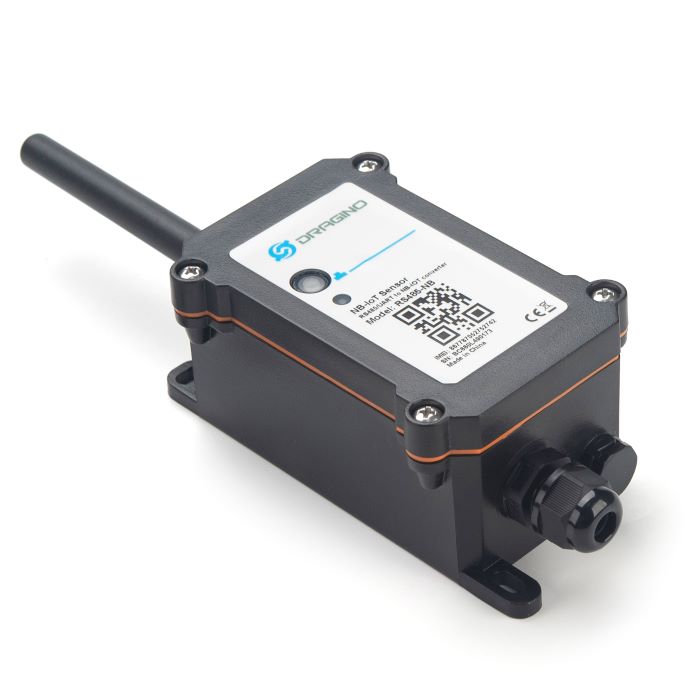


RS485 to NB-IoT converter with UART and M16 cable gland Dragino RS485-NB M16/GE
The Dragino RS485-NB M16/GE is a battery-powered NB-IoT converter for connecting RS485, UART, and digital sensor signals to an IoT platform. It fits distributed monitoring points in industry, buildings, agriculture, and infrastructure where existing sensors need NB-IoT backhaul without local data cabling.
incl. VAT65,33 €excl. VAT54,90 €plusShipping Costs
Related items

Dragino DR-TS1 Turbidity Sensor for Water Quality
incl. VAT289,05 €excl. VAT242,90 €plusShipping Costs1 in stock

LoRaWAN Modbus RS485 converter EU868 Milesight UC100
incl. VAT52,24 €excl. VAT43,90 €plusShipping Costs5 in stock

RS485 to LoRaWAN Converter Dragino RS485-LN
incl. VAT59,38 €excl. VAT49,90 €plusShipping Costs5 in stock
Grand total: incl. VAT0,00 €excl. VAT0,00 €plusShipping Costs
Product Description
Technical Details
The Dragino RS485-NB M16/GE is designed to bring existing field sensors with RS485, UART, or interrupt output into an NB-IoT deployment. Instead of replacing the sensor itself, the converter keeps the installed sensor in use, reads its data at intervals, and sends the values over NB-IoT to the platform. This is especially useful where sensing points are spread out and there is no practical wired communications path.
Typical use cases include water and environmental monitoring points, tanks, shafts, pump stations, technical building systems, agricultural monitoring points, and remote industrial sites. In many of these projects, there are already sensors with Modbus or UART output, but no simple way to move their data into a modern IoT system. That is exactly where the RS485-NB fits.
The converter supports RS485 sensors, 3.3 V or 5 V UART TTL sensors, and interrupt sensors. It also provides controllable 3.3 V and 5 V outputs for powering external sensors. This matters in battery-powered deployments because an external sensor can be powered only when needed for sampling, helping reduce overall energy use.
For integrators, the RS485-NB is useful when different kinds of field devices need to be tied into one NB-IoT architecture. Modbus support, multiple uplink protocols, and flexible sampling make it easier to reuse existing sensor hardware rather than rebuilding the measurement side from scratch. The M16/GE version is the variant with M16 cable entry.
One important point for this version: it is battery-operated, not solar-powered. The 8500 mAh Li/SOCl2 battery is intended for long service life. BLE configuration and OTA updates simplify deployment and maintenance in the field.
| Model | Dragino RS485-NB M16/GE |
|---|---|
| Product type | RS485/UART to NB-IoT converter |
| Wireless technology | NB-IoT |
| NB-IoT module | BC660K-GL |
| NB-IoT bands | B1/B2/B3/B4/B5/B8/B12/B13/B17/B18/B19/B20/B25/B28/B66/B70/B85 @H-FDD |
| Interfaces | 1 x RS485, 1 x UART 3.3 V or 5 V, 1 x interrupt or digital IN/OUT, 1 x I2C, 1 x one-wire |
| Sensor power outputs | Battery-controlled output 2.6 V to 3.6 V, controllable +5 V output |
| Supported sensors | RS485 sensors, 3.3 V/5 V UART TTL sensors, interrupt sensors |
| Modbus support | Yes |
| Interrupt uplink | Yes |
| Sampling | Multiple sampling and one uplink |
| Uplink protocols | MQTT, MQTTs, TCP, UDP |
| Uplink | Periodic |
| Downlink | For configuration changes |
| Bluetooth | Bluetooth v5.1 |
| Configuration | BLE, AT commands |
| Firmware update | OTA |
| SIM | Nano SIM slot for NB-IoT SIM |
| Cable entry | M16 |
| Supply voltage | 2.5 V to 3.6 V |
| Battery type | Li/SOCl2, non-rechargeable |
| Battery capacity | 8500 mAh |
| Self discharge | <1% per year at 25 °C |
| Max continuous current | 130 mA |
| Max boost current | 2 A, 1 second |
| STOP mode consumption | 10 µA at 3.3 V |
| Max transmit power consumption | 350 mA at 3.3 V |
| Operating temperature | -40 to 85 °C |
| Ingress protection | IP67 |
| Note | Battery-operated version, not solar |


